

Why Animal Models Often Fail to Predict Human Subcutaneous Absorption
Subcutaneous (SC) administration has become one of the fastest-growing routes of delivery for biologics. From monoclonal antibodies and fusion proteins to emerging peptides and oligonucleotide therapies, developers are increasingly turning to subcutaneous delivery to improve patient convenience, reduce healthcare costs, and enable at-home administration.
Despite its advantages, predicting subcutaneous absorption in humans remains one of the most challenging aspects of drug development. Animal studies have traditionally been the primary tool for assessing absorption, bioavailability, and pharmacokinetic performance, but translating these findings to humans is often far from straightforward. Molecules that perform similarly in preclinical species can exhibit very different behavior in humans, sometimes leading to unexpected clinical outcomes, reformulation efforts, and increased development costs:
Animal-to-human "Translational success rates ranged from 0 to 100%." across 121 studies [1]
“Bioavailability in monkeys was higher than in humans, with 11 out of 14 monkey values exceeding human bioavailability." [2]
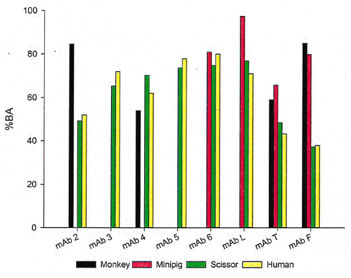
“For mAbs, the cynomolgus monkey tends to overestimate the extent of absorption/ bioavailability” (E.g 98% in monkeys vs 50% in humans) [3]
“%BA outcomes in man often do not correlate with preclinical data[MB4.1].” [4]
Why Subcutaneous Absorption Is Difficult to Predict
The challenge stems from the complexity of the subcutaneous environment itself. Unlike intravenous administration, where a drug is delivered directly into systemic circulation, a subcutaneously administered molecule must first navigate a highly dynamic biological space. Following injection, the formulation may interact with extracellular matrix components, experience changes in local concentration and pH, and may undergo aggregation, precipitation, or tissue retention. For larger molecules such as monoclonal antibodies, transport through the lymphatic system often becomes a critical step before systemic absorption can occur. Each of these processes can influence both the rate and extent of absorption, ultimately affecting clinical performance.
Species Differences in Subcutaneous Tissue Structure
While animal models provide valuable information during development, they cannot fully replicate the human subcutaneous environment. One of the most significant limitations is the difference in tissue structure between species. The composition of the subcutaneous space varies considerably across rodents, minipigs, non-human primates, and humans. Factors such as adipose tissue content, collagen density, extracellular matrix composition, and interstitial fluid dynamics all influence how a formulation disperses after injection. A drug that distributes efficiently in one species may behave quite differently in another, making direct translation of subcutaneous absorption data difficult.
Lymphatic Uptake Varies Between Species
Differences in lymphatic physiology add another layer of complexity. Large biologics often rely heavily on lymphatic uptake following subcutaneous administration, yet lymphatic vessel density, drainage pathways, and flow rates vary between species. Since the lymphatic system plays a central role in the absorption of many therapeutic proteins, these physiological differences can significantly impact observed subcutaneous bioavailability and pharmacokinetic profiles. What appears to be an accurate predictor in one animal model may therefore provide a misleading picture of human absorption.
Injection Conditions Rarely Match the Clinic
Administration conditions can also contribute to poor translation. Clinical subcutaneous injections are frequently delivered using specific devices, injection rates, and volumes that may not be replicated during animal studies. Furthermore, the injection site itself often differs between preclinical and clinical settings. These variations can influence depot formation, local tissue responses, and absorption kinetics, creating additional uncertainty when extrapolating animal data to humans.
High Variability in In Vivo Data
A key challenge with animal studies is the inherent variability of in vivo data, even within the same species and under controlled experimental conditions. Differences between individual animals, injection sites, physiology and biological responses can result in substantial variability within a dataset, sometimes with standard deviations as high as 50%. This makes it difficult to distinguish genuine formulation or performance differences from biological noise, reducing confidence in comparisons and making it challenging to use these results to guide formulation decisions or reliably predict human outcomes.
Why Animal Data Rarely Predicts Human Subcutaneous Bioavailability
The result is a persistent translation challenge that has been recognized throughout the industry. Animal models can often be useful for identifying major risks or comparing formulations within a study, but they are generally less reliable for quantitatively predicting human subcutaneous bioavailability. This limitation becomes increasingly important as companies pursue more complex development programs, including high-concentration biologics, IV-to-SC conversions, co-formulated antibodies, long-acting injectables, and novel biologic modalities. In these cases, understanding how a formulation behaves specifically within the human subcutaneous environment becomes critical for making informed development decisions.
How New Approach Methodologies (NAMs) Help Close the Gap
As a result, many organizations are beginning to supplement traditional animal studies with additional new approach methodologies (NAMs) that provide greater mechanistic insight. Advances in physiologically based pharmacokinetic modelling, in vitro testing platforms, imaging technologies, and integrated in vitro-in silico workflows are helping scientists better understand the events occurring at the injection site before a drug reaches systemic circulation. Rather than focusing solely on pharmacokinetic endpoints, these approaches seek to uncover the underlying factors driving absorption behavior.
Improving Prediction of Human Subcutaneous Absorption
Animal studies will undoubtedly remain an important component of biologics development. However, as the industry continues to push towards more complex molecules and more sophisticated subcutaneous products, relying on animal models alone is unlikely to provide all the answers. A more complete understanding of subcutaneous absorption will require combining traditional in vivo studies with human-relevant mechanistic tools that can help bridge the gap between preclinical observations and clinical outcomes.
By improving our ability to predict human subcutaneous absorption earlier in development, the industry has an opportunity to reduce risk, accelerate decision-making, and increase confidence when advancing candidates towards the clinic.
Frequently Asked Questions
Why do animal models often fail to predict human subcutaneous absorption?
The subcutaneous tissue structure, lymphatic physiology, and injection conditions differ between rodents, minipigs, non-human primates, and humans. These differences change how a formulation disperses, how long it is retained at the injection site, and how it reaches systemic circulation. High variability in in vivo data adds further uncertainty when extrapolating animal results to humans.
Do monkeys overestimate the subcutaneous bioavailability of monoclonal antibodies?
In many cases, yes. Published comparisons have shown that cynomolgus monkeys have overestimated the extent of subcutaneous absorption for mAbs. In one analysis, 11 out of 14 monkey bioavailability values exceeded the corresponding human values, with examples of around 98% bioavailability in monkeys compared with about 50% in humans.
Why is lymphatic uptake important for subcutaneous absorption of biologics?
Large molecules such as monoclonal antibodies are generally too big to diffuse rapidly into blood capillaries, so they rely heavily on the lymphatic system to reach circulation. Because lymphatic vessel density, drainage pathways, and flow rates vary between species, lymphatic uptake in animals may not reflect what happens in humans.
What are new approach methodologies (NAMs)?
New approach methodologies (NAMs) are human-relevant methods used to supplement, or reduce reliance on, traditional animal studies. They include in vitro testing platforms, physiologically based pharmacokinetic (PBPK) modelling, imaging technologies, and integrated in vitro-in silico workflows that help explain what happens after subcutaneous injection.
References:
Cathalijn H C Leenaars, Carien Kouwenaar , Frans R Stafleu, André Bleich, Merel Ritskes-Hoitinga, Rob B M De Vries, Franck L B Meijboom, "Animal to human translation: a systematic scoping review of reported concordance rates", PubMed National Center for Biotechnology Information.
Jason D Robarge, Kevin M Budge, Lucy Her, Andrea M Patterson, Patricia Brown-Augsburger, "Rat as a Predictive Model for Human Clearance and Bioavailability of Monoclonal Antibodies", PubMed National Center for Biotechnology Information.
Wolfgang FRichter, Suraj G Bhansali, Marilyn E Morris, "Mechanistic Determinants of Biotherapeutics Absorption Following SC Administration", PubMed National Center for Biotechnology Information.
Hanne Kinnunen Bown, Catherine Bonn, Stefan Yohe, Daniela Bumbaca Yadav, Thomas W Patapoff, Ann Daugherty, Randall J Mrsny, "In vitro model for predicting bioavailability of subcutaneously injected monoclonal antibodies", PubMed National Center for Biotechnology Information.
