Log P vs Log D: Choosing the Right Measurement Method
Why pH matters
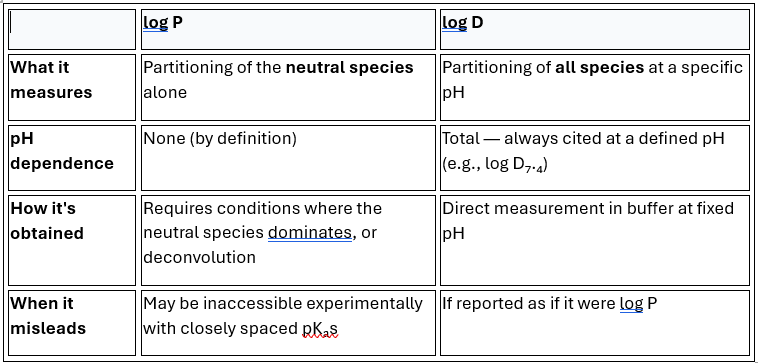
In drug development, log P refers to the logarithm of the partition coefficient — a measure of how a compound distributes between two immiscible phases, typically octanol and water. It quantifies intrinsic lipophilicity, but only for the neutral species, by definition. Consequently, log P is independent of pH.
By contrast, log D describes the distribution of all species present at a given pH — neutral and ionized alike. Since ionized forms partition far less readily into the lipid phase than their neutral counterparts, the apparent lipophilicity of a compound shifts with the pH of its environment, which spans nearly seven units across the body: from stomach (pH ≈ 1–2) to blood (pH 7.4) to urine (pH 4.5–8). A log D value reported without specifying the pH at which it was measured is therefore meaningless.
So far, so textbook. But for many real-world molecules, the divide between these two parameters is not a line you cross by choosing the right buffer — it is a wall, built by the molecule itself. When a compound possesses two closely spaced pKₐs, there may be no pH at which its neutral form ever dominates, and the convenient distinction we just drew collapses into a single, inescapable measurement: logD, whatever the conditions.
What is the difference between log P and log D?
For an ionizable molecule, the difference between log P and log D is not a matter of nomenclature: it is structural. An experiment in buffer at a fixed pH quantifies the distribution of all species present at that pH — which is, by definition, log D. Recovering log P requires that the neutral species constitute 100% of the population, which means knowing the pKas and working at a pH at least 3–4 units away from each of them.
With a monoprotic acid or base, trivial. With molecules whose neutral species is an intermediate protonation state —flanked by charged states on both sides — the uncomfortable problem arises: there may be no pH at which the neutral species is the majority. And without quantitative neutrality, there is no log P. Only log D, whatever the experimental condition.
Why closely spaced pKa values complicate log P measurement
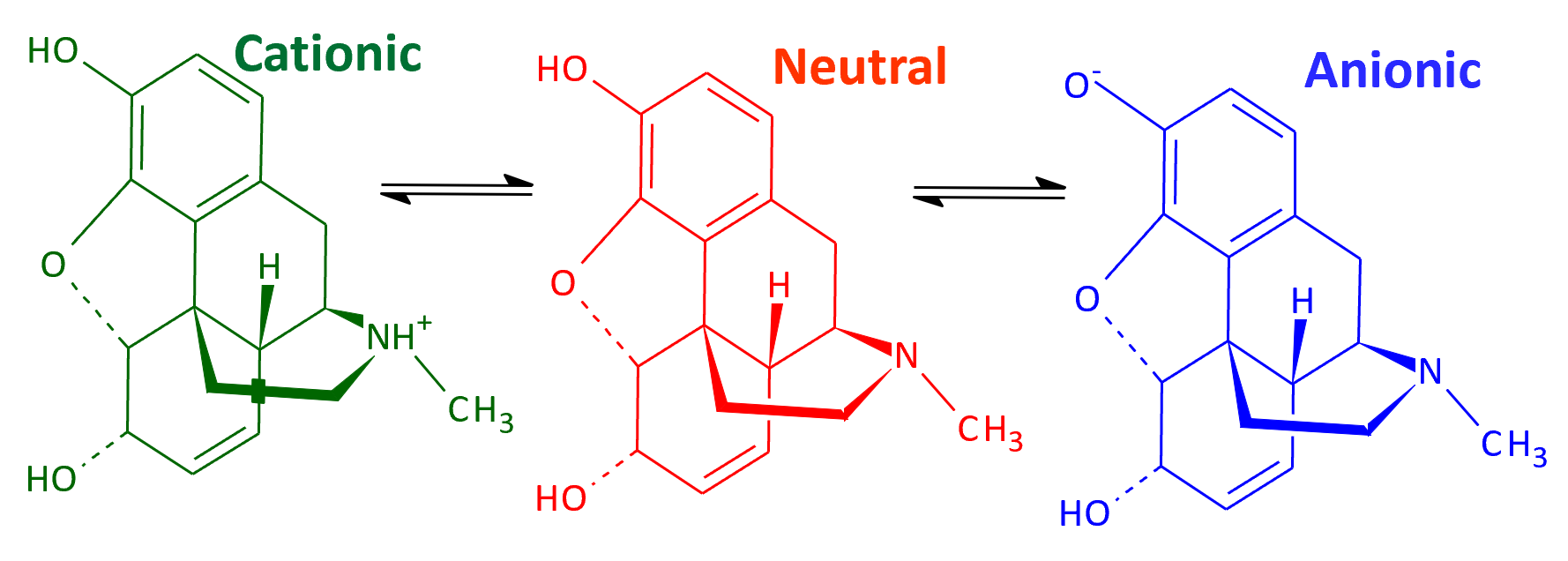
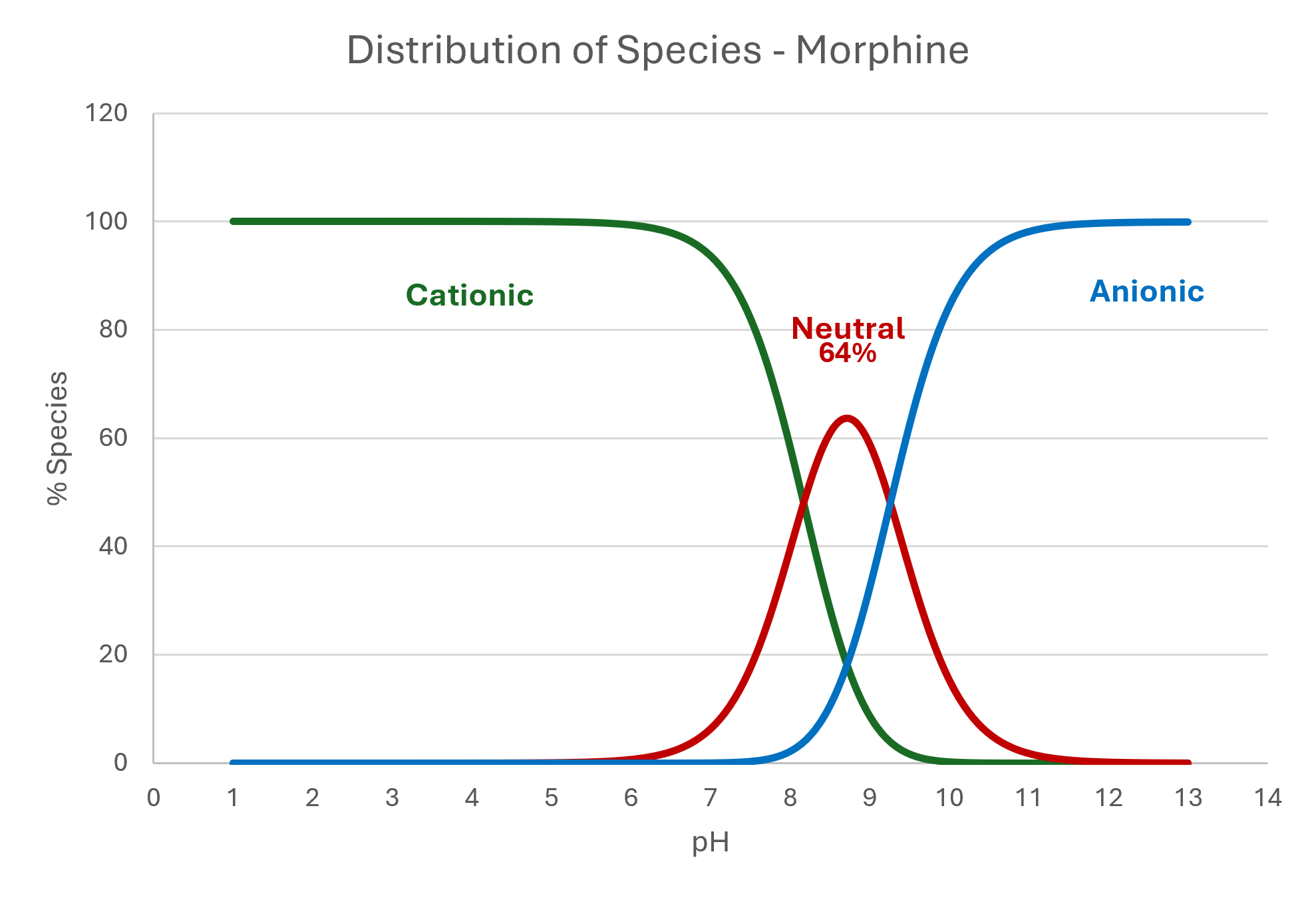
Consider a molecule with two closely spaced pKas. Morphine, as an example of an ampholytic substance (basic pKa₁= 8.17; acidic pKa₂ = 9.26). Between the two pKas, the neutral fraction passes through a maximum whose magnitude is dictated by a pKa separation of ΔpKa = 1.1; that maximum is ~ 64%. Never 100%. Not by buffering, not by shifting the pH, not by replicating the assay. The classic shake flask, its miniaturized UV plate variants, HPLC with buffered mobile phase: all of them measure within this window a log D contaminated by charged species.
The only rescue strategy is to measure logD at multiple pH values and deconvolute the contributions of each species by applying the partition model — with the right pKas, under the right conditions. Feasible in theory, awkward in practice: each data point adds its own experimental error, and in the end one is reconstructing by hand, with compounded uncertainty, what another platform determines from first principles— SiriusT3.
pH-metric potentiometry: defusing theproblem instead of dodging it
The pH-metric potentiometric method reverses the flow. It first determines the pKa under identical conditions of ionic strength and temperature; then it repeats the acid–base titration in the presence of octanol. The displacement between the two Bjerrum curves encodes the partitioning of each species, and the global fit — solved by the SiriusT3 Refine software — decouples the contributions one by one, accounting for the partitioning of the neutral species as well as that of the ionized species into octanol. The result: the log P of the neutral species, regardless of its population fraction. The neutral form does not have to dominate the partition to be thermodynamically characterized.
And here lies the elegant part. Once log P,the pKas, and the partition constants of the relevant species have been determined under the same conditions, the complete log D(pH) profile is derived from the species-partition model — an algebraic consequence, not a sum of experiments. One obtains the continuous curve at any physiological pH, in any compartment, without a single additional assay. The shake flask delivers frames; potentiometry delivers the whole film with the script included.
Immediate practical consequences: since it relies on electrochemical detection, it is irrelevant whether the molecule lacks a chromophore — aliphatic amines, saturated carboxylic acids, intermediates without aromaticity are no longer excluded by their UV silence; there is no analytical method to develop and no per-compound calibration; and systems with closely spaced pKas stop being a dead end.
When to use potentiometry or shake-flask methods
Nothing comes free. Potentiometry requires ionization within its operating range (pKa ≈ 3–11): a permanently neutral compound is invisible to the electrode and goes back to the shake flask, which for that population remains the direct, regulatory reference (OECDTG 107). Optical methods keep their cards — chromatographic specificity against impurities, regulatory validity, coverage of non-ionizable molecules — and they pay for them with analytical development and with that structural inability to access log P when the pKas bunch together.
The takeaway
Next time you read a log P, ask where itcomes from. If it came out of a buffered experiment and the molecule is multifunctional with closely spaced pKas, there is a real chance you are looking at a log D under a borrowed name. This workflow — pKa first, log P second, the log D(pH) profile as a derivation — has become routine in discovery with SiriusT3, and not for throughput reasons: but because in certain cases, the right question only has an answer along one path. Choose the method for the question, not out of habit.