

In today’s increasingly competitive pharmaceutical landscape, generic drug developers face mounting pressure to accelerate timelines, reduce costs, and ensure regulatory success without compromising product performance. At the center of this challenge lies one critical question: how can formulators improve bioequivalence testing early in development?
For decades, in vitro dissolution testing has been the cornerstone of formulation screening. But as drug molecules become more complex and formulation strategies rely more heavily on functional excipients, it has become clear that dissolution alone is not enough.
A more integrated, physiologically relevant approach is emerging—one that could fundamentally reshape how generic formulations are evaluated before they ever reach clinical trials.
The Hidden Risk in Formulation Flexibility
Generic drugs must demonstrate the same safety and efficacy as their reference products, but they are not required to replicate the exact formulation. This flexibility allows manufacturers to select alternative excipients to optimize manufacturability, cost, or supply chain resilience.
However, this freedom introduces risk.
Even small formulation changes, such as switching from one filler or solubilizer to another, can significantly alter how a drug behaves in the body. While these changes may not dramatically affect dissolution profiles, they can substantially impact drug absorption, ultimately determining whether a product meets bioequivalence criteria.
This disconnect is particularly critical for poorly water-soluble compounds, where the interplay between solubility and permeability becomes a defining factor in bioavailability.
Why Conventional Dissolution Testing Falls Short
Traditional USP dissolution methods remain essential for quality control, but their predictive power in bioequivalence testing is limited.
The core issue lies in how these tests are designed. In the human body, drug dissolution and absorption occur as a continuous, interconnected process. In contrast, conventional in vitro methods evaluate them separately—if absorption is considered at all.
This separation creates a gap between laboratory results and clinical outcomes.
The problem becomes even more pronounced when formulation strategies involve solubilizing excipients such as surfactants, cosolvents, orcyclodextrins. While these additives can enhance apparent solubility, they may also:
- Reduce the free drug fraction available for absorption
- Cause micellar entrapment
- Alter membrane permeability
In such cases, a formulation may appear promising in dissolution testing but fail to deliver adequate systemic exposure in vivo.
For formulators, this represents a costly blind spot that often only becomes visible during late-stage bioequivalence testing.
Bridging the Gap: Simultaneous Dissolution–Permeation Testing
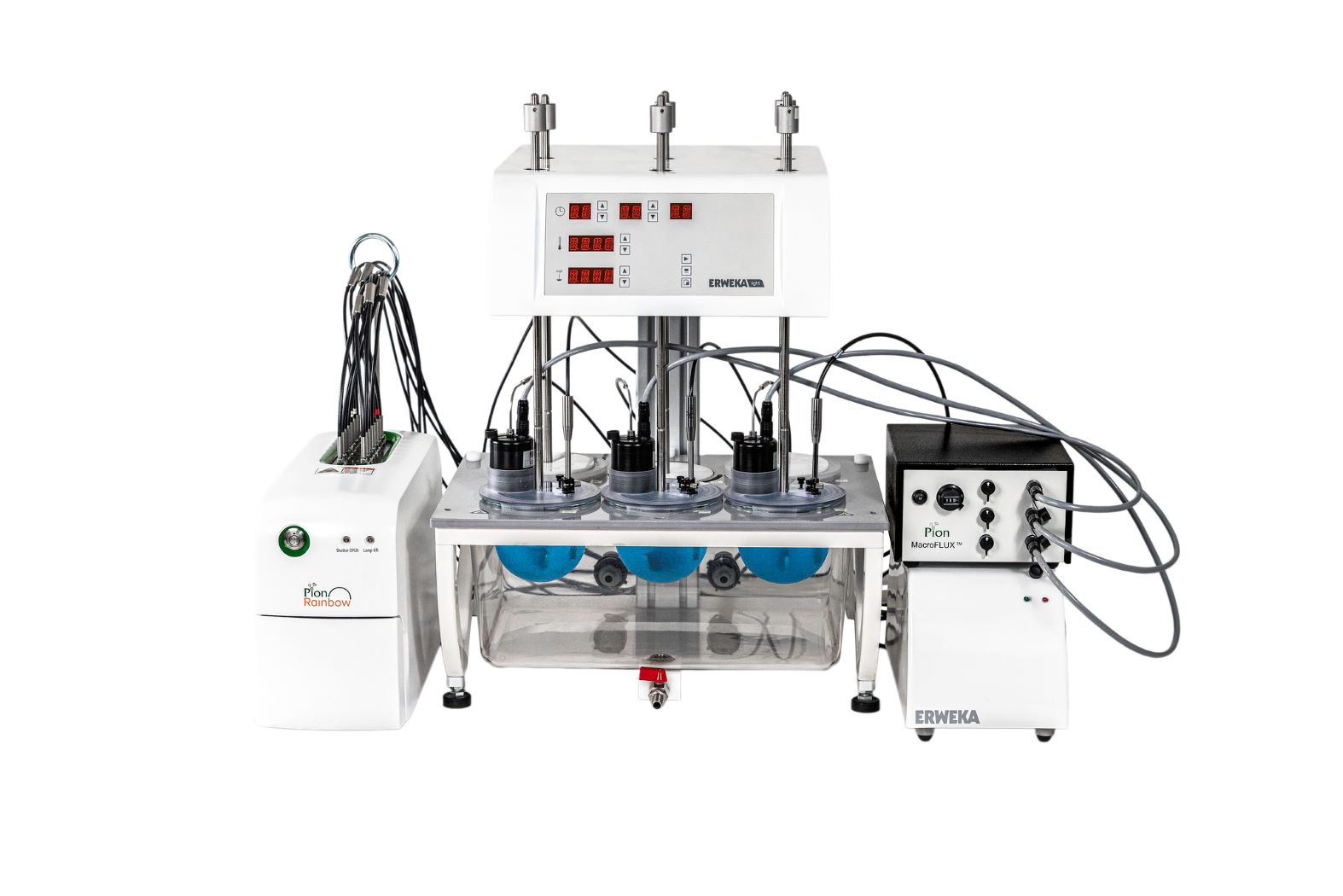
To address these limitations, a new class of in vitro methods has emerged: simultaneous dissolution–permeation FLUX-based testing.
Unlike conventional approaches, these systems measure drug release and membrane transport in real time within a single experiment. By incorporating a biomimetic membrane that separates donor (formulation) and acceptor (systemic circulation) compartments, they provide a more realistic simulation of in vivo absorption.
This integrated approach enables formulators to:
- Evaluate how excipients influence both dissolution and permeability
- Quantify the rate of drug permeation across a membrane
- Better predict in vivo bioavailability and bioequivalence outcomes
- Identify high-risk formulations earlier in development
The result is a more holistic understanding of drug performance that aligns more closely with clinical reality.
Case Insight: Small Changes, Big Impact
The value of this approach becomes evident when examining real-world formulation scenarios.
Telmisartan: Sensitivity to Excipient Selection
In comparative studies of multiple telmisartan formulations, simultaneous dissolution–permeation testing revealed something that traditional dissolution methods could not: formulations with nearly identical dissolution profiles exhibited markedly different permeation behavior.
Subtle excipient substitutions, such as switching from sorbitol to mannitol or modifying salt forms, led to measurable reductions in drug permeation across the membrane. These differences aligned closely with observed in vivo bioequivalence outcomes.
In one case, a formulation that fell near the lower boundary of bioequivalence in clinical studies also demonstrated reduced permeation in vitro highlighting the predictive power of evaluating both solubility and permeability.
For formulators, this underscores a critical insight: It is not just how much drug dissolves, but how much is available to permeate and be absorbed that should be evaluated to determine bioequivalence.
Itraconazole: Distinguishing Bioequivalence vs. Non-Equivalence
The approach is equally powerful in identifying formulations that are not bioequivalent.
Itraconazole, a highly lipophilic BCS Class II drug, presents well-known challenges due to its poor aqueous solubility and complex absorption behavior. Multiple marketed formulations including capsules, oral solution, and advanced solid dispersions exhibit significantly different bioavailability profiles.
Simultaneous dissolution–permeation studies successfully predicted:
- The lack of bioequivalence between capsule and solution formulations
- The significantly higher bioavailability of the oral solution
- The impact of fed vs. fasted conditions on absorption
These predictions closely matched clinical data, demonstrating that FLUX-based methods can differentiate not only subtle variations, but also clear failures in bioequivalence.
Implications for Generic Drug Development
For generic drug formulators, the implications are significant.
1. Better Early-Stage Decision Making
By identifying formulations with poor absorption potential early, teams can avoid advancing high-risk candidates into expensive clinicaltrials.
2. Improved IVIVC (In Vitro–In Vivo Correlation)
Simultaneous testing provides a more direct link between lab data and clinical outcomes, strengthening confidence in formulation decisions.
3. Reduced Development Time and Cost
Fewer failed bioequivalence studies translate into faster approvals and lower overall development costs.
4. Smarter Excipient Selection
Understanding how excipients influence both solubility and permeability enables more rational formulation design.
Moving Toward a More Predictive Paradigm
As regulatory expectations evolve and drug molecules become increasingly challenging, the need for more predictive, physiologically relevant in vitro tools will only grow.
Dissolution testing will remain a foundational component of pharmaceutical development. But on its own, it cannot fully capture the complexity of drug absorption.
For generic drug developers seeking to de-risk programs and improve success rates, the path forward is clear: To integrate dissolution and absorption into a single, unified evaluation strategy.
Conclusion
Bioequivalence is ultimately about what happens in the body and not just in a dissolution vessel.
By embracing simultaneous dissolution–permeation testing, formulators can gain deeper insight into how their products will perform in vivo, long before clinical studies begin. This shift from isolated measurements to integrated understanding represents a powerful step toward more efficient, reliable, and successful generic drug development.
In an industry where small formulation differences can make or break approval, seeing the full picture of drug absorption is no longer optional—it’s essential.
